
DID YOU KNOW?
Even if you don’t have a car, these proposals could still affect you.
Residents can apply for up to 40 Visitor Permits per year, currently £5 for a six-hour block of time. That is a fixed time period so, even if not used, cannot be carried over. Just think how many would be needed for e.g. family celebrations or visits. In addition, permits must be purchased, in advance, in blocks of 5 costing £25. That might be prohibitive for some residents. The Equality Impact Screening Assessment particularly noted a negative impact for low income households.
At the moment, there are no special dispensations for care, medical visits or pharmacy drop offs. Without dispensations, the cost of parking may end up being added to costs when currently such visits/pharmacy delivery services are free
Residents in Mount Florida get free parking permits on event days but, despite being seriously impacted by the parking influx, residents in Battlefield and Shawlands will be expected to pay.
All the parking issues, identified by the council i.e. on pavements, dropped kerbs, hatching and emergency access points; safety issues for pedestrians and cyclists; and blockages for emergency and refuse vehicles, can be addressed by existing enforcement legislation. The imminent rollout of 20mph speed restrictions, to the majority of local streets, should also help to address safety issues for pedestrians and cyclists.
The council has publicly stated that they are struggling to fill parking warden vacancies
At the moment, the council has no specific Parking Strategy.
New-build owners will not be able to purchase residents’ parking permits even if insufficient onsite parking.
HMO residents will also be prevented from buying permits
If local businesses are forced to close because of costs, this will inevitably impact on the number of local jobs available
Local organisations that rely on volunteers may find that they will struggle to retain them if they have to pay nearly £5 per hour to donate their time.
Local community spaces may struggle to be financially sustainable, if there is a loss of revenue due parking charges. This could include playgroups, exercise groups, choirs and many, many more. There’s no evidence that everyone who uses these services will be able to walk, wheel, cycle or have access to a suitable public transportation route, especially on a Sunday, when such services operate a reduced timetable
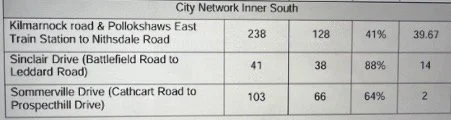
Of the surveys, made available on the Council website, (Active Travel Strategy City Network, June 25) all indicate more spaces available than used. Parking capacity is available rather than being overwhelmed.
In 2016, Shawlands and Battlefield were identified as areas where complaints were made. In the case of Battlefield specifically, this was noted as the area around the Scottish Power building, which is no longer there. No details were listed for Shawlands.
In 2019, both were again listed though this time the detail about the Scottish Power building was removed. In both cases, the nature, type and frequency of complaints was not listed and, to date, none have been publicly recorded.
A Freedom of Information (FOI) request elicited that the council held no emails, Teams messages, minutes or notes regarding Battlefield being identified for parking controls.
(Requests for Shawlands and Strathbungo pending)
The Council’s own guidance is clear that it should not undertake a consultation if there is currently one ongoing or recently completed in the same or similar geographical area or topic. The council did not abide by this rule.
There could be issues with hospitality staff in terms of poor public transport options late at night, when shifts finish as highlighted in the Fraser of Allander Institute’s Serving the Future report.
In the council communication, Clyde Metro is mentioned as a transport option. However, this is not guaranteed as the new 10-year City Development Plan states that ‘it may be more likely that a significant amount of the scheme would be delivered in the next (10-year) plan
Issue of Contractor/ Services Visits:-
According to the Fraser of Allander Institute:-
‘There’s an issue with visiting tradesmen and services are done by van of where do they park? You can apply to the city council for a parking dispensation. They have the policy that no parking should be free and so you’d have to pay for something, but it may allow a van if there’s work going on to park for longer, but that’s also complicated process in itself just to go through to apply for that.
Residential visiting passes exist. So these are sold at five pound for a set six hour period, but it’s a set of six hours. If the workmen needs longer than three hours, which they’d be paying on the street for, they need to effectively schedule with their time. It’s almost an equity thing there where the impact of this will be more severe on certain types of workers than it will be on others’.
Also according to the FOAI businesses often overstate the impact parking controls will have, citing experiences in the West end of the city. The Federation of Small Businesses disagrees.
‘The experience of traders elsewhere in Glasgow and in other parts of the UK underlines the risk of parking charges damaging local high streets. Businesses in Glasgow's West End, Byres Road and Lanes BID (Business Improvement District) has reported sales drops of up to 30 per cent among some businesses following fee increases in 2024. Economic modelling conducted for Shrewsbury BID found even modest tariff increases would reduce local footfall and curtail consumer spending. Hisashi Kuboyama, FSB's development manager for Glasgow, said: "Small businesses on the Southside are resilient, but our local high streets are fragile with ever-rising costs and significant competition from out-of-town shopping centres and online retail’.
"These proposals introduce some of the longest and most expensive parking controls anywhere in the UK outside London, and they threaten to choke off the footfall that many businesses rely on. Small firms are not opposed to well-designed transport policy, but they need a system that is proportionate, evidence-based and sensitive to how neighbourhood economies function."
The Equality Impact Screening Assessment, that the council was required to carry out, was signed off the day after the consultations closed. Given that it identified several issues, it would have made more sense to delay the consultation until *full mitigations had been agreed.
Several protected characteristics were identified as being negatively impacted, to one extent or another, including Women, Age, Disability and Religious Belief.
‘Summary of Protected Characteristics Most Impacted
It is anticipated that people with disabilities, in addition to care givers and receivers would be most impacted by these proposals. There are specific exemptions in place for those with protected characteristics for disability:
Visitor permits can be allocated to carers; however, * it is recommended that additional exemptions be made for care and medical visitors.
Summary of Socio Economic Impacts
Increased living costs for majority of residents if vehicle does not fall within the low pricing band.
• May not have funds to purchase a new vehicle that falls within cheaper rate
- May not have capability to install charging infrastructure at their home due to either financial circumstances or property type
- The cost of both parking and visitor permits may be prohibitive for those lower incomes which could be particularly prevalent amongst the younger and older populations who may not be in active or full-time employment. The same can be said for places where on-street ‘pay to park' charges apply which may deter people of all age groups from using local businesses and amenities, opting to visit retail parks or shopping areas that provide free parking.
Data released by the Office for National Statistics in 2021 identified that the youngest age group (16-24) and oldest age group (65+) have the least amount of disposable income, therefore, the cost implications associated with parking permit charges are likely to have a greater impact on those age groups.
It is anticipated that the socio-economic group most impacted by the proposals would be:
- Households in middle low income brackets, above the poorest households with no car access but not within the typically more affluent multi-vehicle households.
The mitigation for this impact is to make permits payable quarterly at a total cost equal to annual payments, meaning permit holders are not penalised for paying in instalments.’
The New Victoria Hospital delivers many services and clinics to a very wide geographic area, including as far north as Oban, even Inverclyde and Paisley. Current on-site parking is proving insufficient despite public transport options which may not be suitable for all who need to attend. This is especially true for those having chemotherapy treatment who, due to lowered immunity, need to avoid crowded areas. Many on-street parking spaces have already been lost e.g. along the side of the park and more will go shortly when the new cycle path is constructed in front of the hospital then continuing along Battlefield Road to the railway bridge.